Gespeelde partijen:
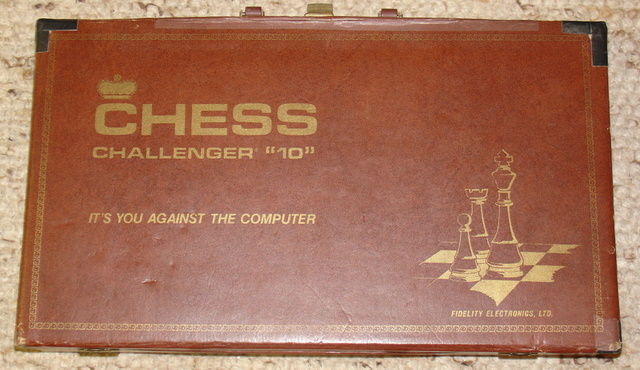
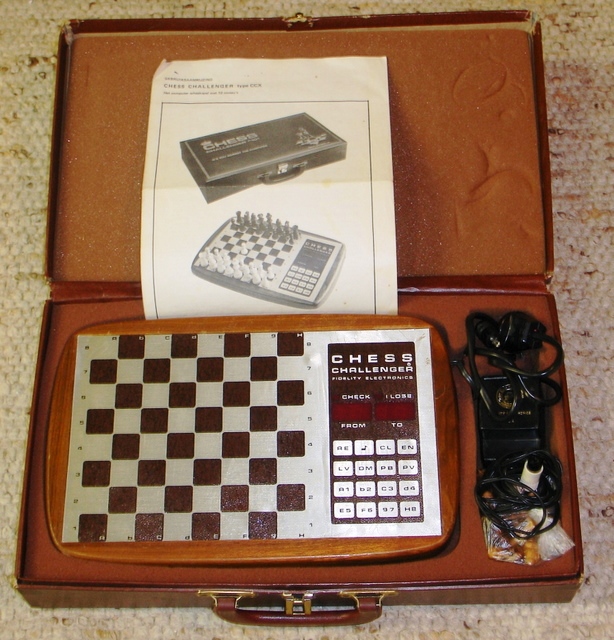
Fidelity CC 10B - Hein Veldhuis Fidelity level 10, 3 min/move, 02.09.1985
1.d4 d5 2.c4 dxc4 3.d5 e6 4.Nc3 Bb4 5.Qa4+ c6 6.Qxb4 cxd5 7.Nf3 Nc6 8.Qc5 h6 9.e4 Nge7 10.Bf4 O-O 11.O-O-O b6 12.Qb5 a6 13.Qa4 Bb7 14.Be2 b5 15.Nxb5 axb5 16.Qxb5 Ba6 17.Qc5 Qd7 18.e5 Rfc8 19.a4 Na7 20.Qd6 Qxd6 21.exd6 Ng6 22.g3 Nxf4 23.gxf4 Rd8 24.Rhg1 Rxd6 25.Ne5 Nc6 26.h4 Nxe5 27.fxe5 Rc6 28.Rg3 Bb7 29.Ra3 Rca6 30.b3 Bc6 31.Rd4 Bb5 32.Kd1 Ra5 33.f4 Rb8 34.h5 Ba6 35.bxc4 Rb4 36.Kd2 Raxa4 37.Rxa4 Rxa4 38.Kc3 dxc4 39.Bxc4 Ra3+ 40.Kb4 Ra1 41.Rd8+ Kh7 42.Bxa6 Rxa6 43.Rb8 Ra1 44.Rd8 Rh1 45.Kb3 Rxh5 46.Rd3 Rf5 47.Rd4 h5 48.Kb4 h4 49.Re4 h3 50.Kb5 h2 51.Re1 Rxf4 52.Rh1 Rh4 53.Kb6 g5 54.Kc7 Kg6 55.Kd6 Kf5 56.Rf1+ Rf4 57.Re1 g4 58.Ke7 g3 59.Kxf7 g2 60.Re4 g1=Q 61.Rxf4+ Kxf4 62.Kxe6 h1=Q {0–1}
Date: 14 juli 1994
White: Chess Challenger 10B
Black: Hein Veldhuis
Level: CL10 - Tournament Level with 3 min./move. 1-0. Comment by Hein Veldhuis
1. d4 Nf6 2. Nc3 g6 3. Nf3 Bg7 4. e4 d5 5. Bd3 Bg4 6. e5 Nh5? {I didn't want to move the knight to d7, because then the trouble starts.} 7. h3 Bxf3 8. Qxf3 Bf8 9. g4 Ng7 10. Qxd5 Qxd5 11. Nxd5 Ne6 12. c3 c6 13. Nf4 Nc7 14. a4 a5 15. Bd2 Nd7 16. Ng2 O-O-O 17. b4? axb4 18. Rb1 bxc3 {Knight taking e5 was of course stronger, but I did not see that.} 19. Bxc3 Nd5 20. Ba5 Re8 21. O-O f6? {I wanted to break open the position, but CC10B didn't agree!} 22. e6! Nb8 23. Rb2 Bh6 24. Rfb1 b6 {In a higher sense I am at a loss here, but maybe I can still get a chance?} 25. Bxb6 Nxb6 26. Rxb6 Kc7 27. Bc4 Bd2 28. Rb7+ Kd6 29. Rd1 Ba5 30. h4 f5 31. gxf5 gxf5 32. h5 Rhg8 33. Rd3 Rg5 {Will I get any resistance after all?} 34. Ra7? Bc7? {It is clear that both sides are having a hard time.} 35. Rb3 Reg8 36. Rbb7 {Rybka 4 thinks the position is perfectly balanced, and I should have played 36. ...Rxg2+ here. But my fear of those two white rooks was so great that I not opted for a counterattack, but for defending my bishop. A very bad decision.} Rc8?? 37. h6 Rg4 38. Bd3 f4 {CC10B doesn't fall into my trap with 39. Bxh7? f3!} 39. f3 Rgg8 40. Kf2 Rgf8 41. Be4 Rf6 42. Bxh7? Rxh6 43. Bd3 Rf6 44. a5 Rff8 45. Bc4 Rf5 46. a6 Rf6 {Didn't see at all that 46. …Nxa6 was still a last possibility.} 47. Ra8 Rff8 48. a7 Nd7 49. Rxc8 Rxc8 50. xd7 Kxd7 51. Rb1? Ra8 52. Rb7 Kc8 53. Ba6 Kd7 54. Ne1? {Why not 54. Nxf4 is a mystery to me.} Kd8 55. Be2? e5? {Of course, here I should have played 55. …Kc8.} 56. dxe5 Bxe5 57. Nc2 Bd6 58. Nd4 Bc5 59. Rb8+ Kc7 60. Rxa8 Bxd4+ 61. Ke1 Kb7 62. Rf8 Kxa7 63. Rxf4 c5 64. Bd3 {Here 64. Rxd4 would also be quickly decisive.} Kb6 65. Rf5 Kc6 66. Bc4 Kb6 67. Rh5 Ka5 68. Ke2 Kb4 69. Kd3 Ka5 70. Rh6 Bb2 71. f4 Bc1 {This last gamble also yields nothing. CC10B has everything under control.} 72. Ra6+ Kb4 73. f5 Bg5 74. f6 Bh6 75. Ra2 Bf8 76. f7 Bg7 77. Ra8 Bh6 78. Bd5 Bg7 79. Bc4 Bh6 80. Rc8 Bg7 81. f8=Q {After some hesitation, a promotion finally arrived.} Bxf8 82. Rb8+ Ka5 83. Rxf8 Kb6 84. Rc8 Ka5 85. Rxc5+ Kb4 86. Rb5+ Ka4 87. Kc3 Ka3 88. Ra5# {I've rarely seen CC10B play so decisively, so he can certainly do it! And that against an opponent who is normally a class above.}
L. Hofman - Fidelity CC 10 B
Level 6, one hour each move, 17.03.2026 0-1
1.a3 {black out of book} d5 2.d4 Nc6 3.h3 Nf6 4.Bf4 Bf5 5.g4 Be4 6.f3 Bg6 7.h4 h5 8.g5 Nd7 9.Nc3 e6 10.e4 dxe4 11.fxe4 Bd6 12.e5 {aggressive play from white, but no advantage yet} Be7 13.Nge2 Nb6 14.Be3 Nc4 15.Bc1 O-O 16.b3 Nb6 17.Be3 a5 18.Nf4 Nd5 19.Ncxd5 exd5 20.Be2 a4 21.b4 Be4 22.Bf3 g6 23.Bxe4 dxe4 24.c4 Qd7 25.Ne2 Rfd8 26.Qb1 Qf5 27.Rf1 Qg4 28.Bf2 e3 29.Bxe3 Qxh4+ 30.Bf2 Qxg5 {more or less equal play, but black is a pawn up} 31.Qe4 f6? 32.Rg1 Bxb4+?? {why a sacrifise of the bishop? Great advantage now for white} 33.axb4 f5 34.Rxg5 fxe4 35.b5 Ne7 36.Ng3 a3 37.Nxe4 Ra4 38.c5 Kg7 39.Ra2 Nf5 40.Ke2? {b6!} Nxd4+ 41.Bxd4 Rdxd4 {the advantage is almost gone for white and black is coming up} 42.Nc3 Ra5 43.Ke3 Rc4 44.Kd3 Rxc5 45.Kd4 b6 46.Rgg2? {white saw Rag2 as a possibility but thought the a pawn would be to dangerous} Ra8 {slight advantage for black now} 47.Rgc2 Ra5 48.Rf2 {e6 better here} Ra8 49.Rf3? Rd8+! 50.Ke4 Rc4+ 51.Ke3 Rxc3+ {knight lost} 52.Ke4 Rc4+ 53.Ke3 Rd5 54.Rxa3 Rxe5+ 55.Kf2 Kh6 56.Rad3 Rcc5 57.Rd8 Rf5 58.Rh8+ Kg7 59.Re8 Rc2+ 60.Kg3 h4+ 61.Kg4 Rc4+ 62.Kh3 Rxf3+ 63.Kg2 Rf5 64.Kh3 Rxb5 65.Re7+ Kf6 66.Re3 Rf5 67.Rd3 g5 68.Rd8 Rc3+ 69.Kg4 Rfc5 70.Rf8+ Ke7 71.Rg8 h3 72.Kh5 h2 73.Rg7+ Kf8 74.Rxg5 h1Q+ 75.Kg6 Qe4+ 76.Kf6 Qc6# {0–1}
Fidelity CC 10 B – L. Hofman Level 6, 60 min./move 26.03.2026
1.e4 e5 2.Nf3 f6? {irregular} 3.Bc4 a6? {irregular and wrong} 4.d4? {4.Nf3xe5! f6xe5 5.Qd1–h5+ g7-g6 6.Qh5xe5+ Qd8-e7 7.Qe5xh8 Qe7xe4+ 8.Bc4-e2} 4...exd4 5.Nxd4 Ne7 6.Nc3 Ng6 7.Be3 Bb4 8.Nf5 {Black’s opening has failed} Bxc3+ {better but not pleasant: Kf8} 9.bxc3 d5? {Kf8} 10.Bxd5 Bxf5 11.Bxb7 {even better exf5} Qxd1+ 12.Rxd1 Bxe4 {a nice way to win at least a pawn} 13.Bxe4 c6 14.O-O Ne7 15.Bc5 Nd7 16.Bxe7 Kxe7 17.Bxc6 {a second pawn for white and a bad postion for black’s king} Rad8 18.Rfe1+ Ne5 19.Rxd8 Kxd8 {Not Rxd8 because of f4} 20.Bb7 Kc7 21.Bxa6 Ra8 22.Bd3 Nxd3 {seems a rather good decision to exchange for surviving} 23.cxd3 Rxa2 24.Re7+? {bad decision} 24...Kd6 25.Re1 {because of black’s Ra1 mate} Rd2 26.d4 {Re3? and Rd1!} Rc2 27.f4 Rxc3 {the miracle has happened} 28.Rd1 Kd5 29.Re1 Rc7 30.f5 {it is already a draw position} Kxd4 31.Rd1+ Ke5 32.Rf1 Rc4 33.g3 h5 34.Rf2 Rc1+ {a little trick hoping for Rf1 from white} 35.Kg2! {35.Rf1?? Rxf1+ 36.Kxf1 h4 37.gxh4 Kxf5 38.Kg2 Kg4 39.h5 Kxh5 40.Kh3} 35...Rc4 36.h3 h4 37.gxh4 Rxh4 38.Rf3 Rf4 39.Rg3 Rxf5 40.Rxg7 Rg5+ 41.Rxg5+ fxg5 42.Kh1 Kf4 43.Kg2 {½–½}
L. Hofman – Fidelity CC 10B level 7 Postal chess, 6 ply search 29.03.2026
1.d4 d5 2.Nc3 Bf5 3.Bf4 Nc6 4.e3 Nf6 5.Bd3 e6 6.a3 Bd6 7.Bxd6 cxd6 8.h3 {the engine rejects this move of course with – 0,30 and suggests Bxf5} O-O 9.Nf3 Ne4 10.Bxe4 dxe4 11.Nd2 d5 12.Qe2 a6 13.O-O-O {so far the opening positions are clear} b5 14.Na2 {white will not permit attacking the knight with b4} Rc8 15.g4 Qc7 16.Nb3 Bg6 17.Nc5 {white is planning to hold the position closed} Ra8 18.h4 h6 19.Rdg1 e5 20.c3 Rfc8 21.h5 {white is beginning to attack} Bh7 22.g5 hxg5? {better is exd4 for creating a contra attack on the c-line} 23.Rxg5 {white had seen that the treath Nxd4 is not wise already} Nxd4? {miscalculation in stead of cxd4. After only 4 ply it is clear that the white knight stays save. The programm should calculate 6 ply on this level} 24.exd4 exd4 25.cxd4 Rd8 26.Rhg1 Qf4+ 27.Kd1 Qf6 28.Rxg7+ Qxg7? {more resistance Kh8} 29.Rxg7+ Kxg7 30.Nc3 Bf5 31.Kd2 f6 32.Qf1 Rh8 33.Qg1+ Kf7 34.Qh2 Bg4 35.Qc7+ Kg8 36.Nxd5 Rf8 37.Ne7+ Kg7 38.Nf5+ Kg8 39.Qg7#
Fidelity CC 10B (Level 7, postal chess, 6 ply search) - L. Hofman 16.04.2026
1.d4 f5 2.Bf4 d5 3.Nc3 Nf6 4.Nf3 a6 5.e3 Nc6 6.Ne5 Bd7 7.Be2 e6 8.Bg5 Be7 9.Bh5+ g6 10.Be2 Nxe5 11.dxe5 Ng8 12.Bxe7 Nxe7 13.O-O Nc6 14.f4 Qe7 15.Bf3 O-O-O 16.Qd2 g5 17.Rad1 g4 18.Be2 h5 19.a3 h4 20.b4 Na7 21.Qd4 Kb8 22.a4 Nc6 23.Qc5 Qxc5 24.bxc5 Ka7 25.Rd2 Be8 26.Rfd1 Bh5 27.Rd3 g3 28.hxg3 hxg3 29.Bxh5 Rxh5 30.e4? {the loss of the knight is 6 ply deep. So why playing e4?} Rdh8! 31.Rxg3 {Kf1 is no alternative because of ….fxe4} d4! {move the knight and the rook on d1 is lost after ….Rh1+} 32.Re1 dxc3 {a knight for two pawns after 35. Rxc3} 33.exf5 Rxf5 34.Re4 Ne7 35.Rxc3 Nd5 {the game looks as lost for white, but it is still a long way} 36.Rf3 Rh4 37.g3 Rh3 38.c4 Ne7 39.Rfe3 Rfh5 40.g4 Rxe3 41.Rxe3 Rh4 42.Rg3 Ng6 43.Kf2 Nxf4 44.Ke3 Ng6 45.Kd4 c6 46.a5 Kb8 {on the move with the king} 47.Rg1 Kc8 48.Rg3 Kd8 49.Rg1 Ke8 50.Ke4 Nh8 51.Rg3 Nf7 52.Rg2 Nh6 53.Kf4 Kf7 54.Rg1 Kg6 55.Rg2 Ng8 56.Rg1 Rh7 57.Ke3 Kg5 58.Rg3 Nh6 59.Rf3 Nxg4+ 60.Ke4 Rd7 61.Rf8 Re7 62.Rg8+ Kh4 63.Rh8+ Kg3 64.Rf8 Nh6 65.Rf1 Nf7 66.Rf3+ Kg4 67.Rf4+ Kg5 68.Rf2 Kg6 69.Rf6+ Kg7 70.Kf4 Nh8 71.Ke3 Ng6 72.Kd4 Nf8 73.Rf1 Rf7 74.Rxf7+? {Rb1 gives more resistance} Kxf7 {game over} 75.Ke3 Kg6 76.Kf4 Nd7 77.Ke4 Nxc5+ 78.Kd4 Nb3+ 79.Kc3 Nc5 80.Kd4 Nd7 81.Ke4 Kg5 82.c5 Nxc5+ 83.Kd4 Nd7 84.Ke4 c5 85.Kd3 Kf5 86.Kc4 Kxe5 {0–1}
Fidelity CC 10B level 7 (postal chess, 6 ply search) - Sargon GGM 2 .5 level 3 (45-90sec.) - 10.05.2026 (Fidelity was emulated in 10x faster response. Even then there are very long waiting times of everage 4-6 hours.)
1.d4 d5 2.c4 e6 3.Nc3 c5 4.cxd5 exd5 5.dxc5 d4 {a lonely pawn on adventure} 6.Na4? {better Ne4, but white wants to defend the pawn at the side of the board} Na6? {better b5} 7.e3 Bxc5 8.Bxa6 Bb4+ 9.Bd2 Qa5 10.Bc4 Bxd2+ 11.Qxd2 Qxa4 12.Qxd4 {bad opening from black, white is a healthy pawn up} Qa5+ 13.Kf1? {aaarrggh! Why not Qc3?} Nf6 14.b4! {the pawn can not be taken because of Bxf7 check} Qf5 15.Bd3 Qg4 16.e4? {better Qc5} Be6 17.h3 Qh5 18.Ne2 Rd8 19.Qc3 O-O {white is still a pawn up but the position of black is better} 20.Nf4 Qg5 21.g3 Rfe8 22.Re1 Nh5 23.h4? {after Nxe6 the position is equal, now Nxg3 is possible with much variation and advantage for black} Qf6? {now white has a better position again} 24.e5 Qh6 25.Nxe6 fxe6? {better Qxe6} 26.Be2 g6 27.Rc1 a6 28.Kg2 Qd2 29.Bf3 Qxc3 {it is not wise to exchange the queens} 30.Rxc3 Re7 31.Rhc1 Ng7 32.Rc8 Rxc8 33.Rxc8+ Kf7 34.a4 b5 35.Ra8 Rd7 36.a5? {Rxa6} Nf5 37.Be4? {Rxa6} Ne7 38.Rh8? {what is the meaning of this?} Kg7 39.Re8? {Ra8} Rc7 40.Bf3 Ra7 41.Rb8 Nd5 42.Bxd5 exd5 43.Rd8 Rc7 44.f4 Rc4 45.Rd7+ Kh6 46.e6 Rxb4 47.e7 Rb2+? {Re4, but also loses} 48.Kf1 Rb1+ 49.Ke2 Rb2+ 50.Kd3 Rb3+ 51.Kd4 Rb4+ 52.Kxd5 Rb3 53.e8Q Rd3+ 54.Kc5 Rc3+ 55.Kb6 Rxg3 56.Rd5 Kg7 57.Qe7+ {after many hours of speed thinking with mate in 2 announcement} Kh6 58.Qf8# {Mate in 1 speed thinking time 1 hour, what means at least 10 hours at normal speed 1–0}